Your next creative batch is ready. Your campaign setup is not.
It is Monday morning. The creative team has delivered a new batch, the US campaigns need attention, and the weekly review is approaching. None of these tasks is unusual. The difficulty is keeping them connected as your team adds accounts, markets, and creative volume.
Your marketers may already use an AI assistant to analyze results or draft a testing plan. But if someone still has to export the data, explain the account again, rebuild the campaign, and check whether the changes happened, much of the operational work stays with the team.
Give the agent a repeatable operating process
Superlaunch connects those pieces: Launcher gives your agent a way to prepare campaigns from approved assets and templates; autorules run defined checks on a schedule; Insights gives the agent synced account data to analyze. Your team decides the targets, reviews the setup, and checks the results.
A weekly launch across two markets
Your team has approved a new batch of acquisition creatives for the US and UK. Your team uses separate accounts, templates, budgets, and launch times for these markets. You want consistent setup and a clear record of what ran.
The following is an illustrative workflow you can adapt to your account.
Run the launch pipeline without rebuilding it each week
Get both markets’ media into approved creatives
Your US and UK batches may arrive from different sources. Upload local image or video files into Launcher, then use the media in draft creatives in Library. For Google Drive, select the files you want to share and import them; those imports create draft creatives for review. A shared folder is not an automatic feed: select each new batch.
Complete the identity, copy, destination, language, and CTA for each market, then approve the content version. Uploading or importing media alone does not make it ready to launch. The creative team and buyer can now review a named, approved version rather than coordinate through loose files.
Use collections and templates to preserve the market setup
Create a fixed collection for an exact market batch, or a smart collection for eligible creatives matching saved criteria. Choose a template version for each market’s objective, audience, placements, naming, and budget. Configure that account’s Launcher campaign and budget limits before the first launch preview.
A saved fixed schedule retains its selected membership; adding a new creative to the collection later does not silently change the schedule. A smart schedule uses its saved matching criteria. For a continuing US testing program, approve new creatives that match those criteria and review the selection before the next run.
Choose one-time or recurring creation deliberately
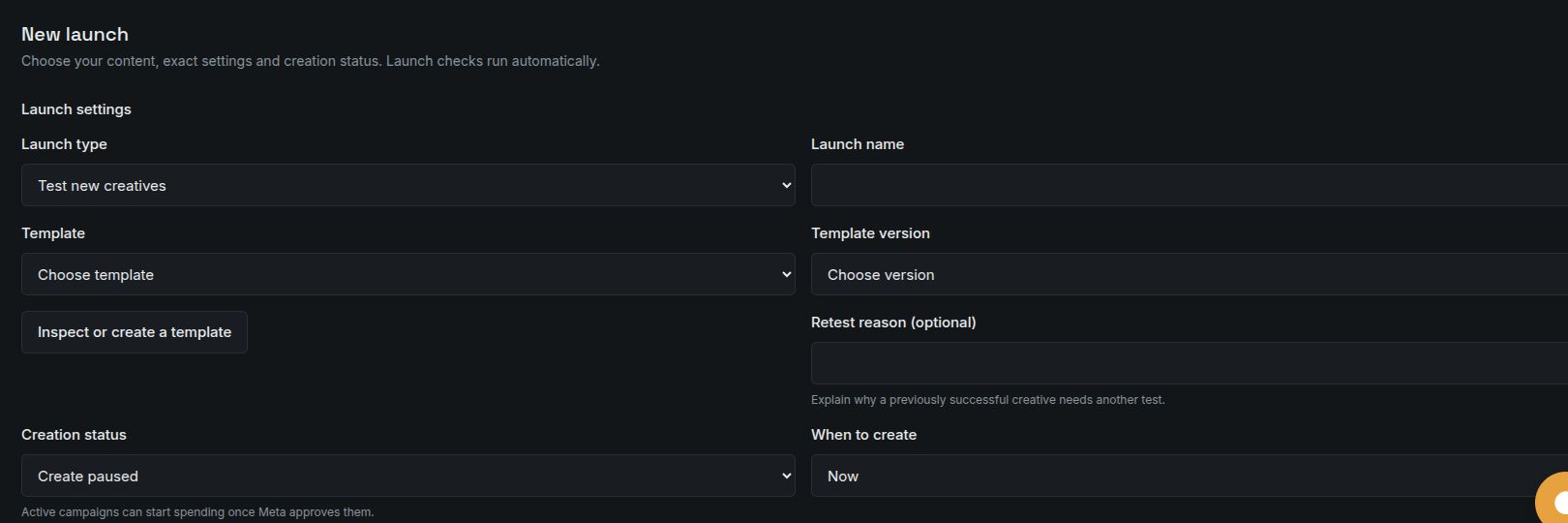
A seasonal UK offer may need one launch now or once at a future date. Launcher provides Now and At a future time for those cases; the future-time control uses the browser’s time zone. An ongoing US Test new creatives workflow can use Repeat automatically, with its own schedule time zone, maximum creatives per run, and maximum exposure per run.
Timing controls when Superlaunch creates the campaign. Creation status controls whether the new ads are paused or activated after creation. Choose Create paused when a buyer needs to inspect the campaigns in Meta first. Active delivery remains subject to Meta approval. Preview the proposed structure and budgets before submitting.
Review what ran before preparing the next batch
Recurring launches select eligible unused creatives. Saved template settings and fixed membership stay pinned; later template edits are not adopted automatically. Missed and overlapping runs are skipped. Check the recorded execution result, including failed items, rather than treating a schedule or accepted request as proof that the campaign exists.
Once your team has enough performance evidence, Promote successful tests and Refresh an existing ad set provide individual follow-up launch operations. They do not automatically identify profitable winners. Your team chooses which test creatives to promote or which creatives to introduce into an existing ad set.
For the complete walkthrough from local files and Google Drive to approved creatives, collections, and schedules, read the creative-launch guide.
Keep the account under review between launches
Launching the batch starts the next operating task: deciding which checks should run while the team is doing other work. Autorules let you define the account scope, metric conditions, schedule, and action. Start with Dry run and inspect the result before allowing changes. An active rule can still be in dry-run mode; applying changes requires active status, dry run disabled, and the appropriate permissions. These are examples to adapt to your economics and tracking.
Pause an ad that spends without purchases
Suppose the team wants to review ads that have spent more than $60 in a chosen reporting window without a recorded purchase. Scope the rule to the intended ads and combine the spend and purchase conditions. Preview the matches, then allow the rule to pause matching ads on its schedule.
The window and conversion event matter. Delayed reporting or a different attribution setting can change which ads match. Choose a minimum amount of evidence that fits the account, and check the rule’s recorded result before changing the threshold.
Increase budgets in controlled steps
For ad sets meeting your ROAS target with enough spend to evaluate, use a budget-increase action with explicit bounds. For example, a team might review a 10% increase with an upper budget bound of $200 in the account currency. The percentage and bound are separate choices.
If the rule checks often and the conditions remain true, it may apply again. Choose the check cadence with that behavior in mind. A budget bound limits the action’s configured result; it is not a promise about total platform spend.
Reduce exposure when acquisition cost rises
A different rule can reduce a campaign or ad-set budget when purchase CPA exceeds the team’s target after sufficient delivery. Define a lower budget bound so repeated reductions stay within the range you intend. Preview which entities match before activation.
Keep this rule’s scope and conditions distinct from the scaling rule. Ask the agent to explain how the two rules would behave on the same entity, and inspect run results if the account moves back and forth around a threshold.
Check a promotion or regional account on its own cadence
A promotion may need more frequent checks than an established campaign. Scope a rule to that campaign and select an hourly, daily, weekly, or supported custom schedule with an explicit time zone. This keeps the review cadence connected to the operating situation.
Scheduled checks are not instantaneous reactions to each conversion or dollar of spend. Superlaunch evaluates on the configured schedule using available data. The team still needs an owner for reviewing failed runs, paused rules, and changes to the promotion plan.
Pause or resume a selected campaign on a repeating schedule
For a campaign that should run during a defined recurring period, configure separate pause and resume rules with the appropriate targeting, conditions, and daily, weekly, or custom schedule. Use separate schedules when regional accounts need different local execution times. Preview the matching entities so a schedule cannot quietly broaden the intended scope.
This is recurring rule execution. For a one-time future campaign creation, use Launcher’s At a future time option. Activation and Meta approval remain separate from creating the campaign.
Mark an item for a human review
Some findings deserve a buyer’s decision before changing delivery. A rule can add a name tag to matching campaigns, ad sets, or ads, making the classification visible when the team reviews them. For example, tag an ad that crosses your spend threshold so the buyer can inspect its creative and conversion evidence.
A name tag is not an email or chat notification. Choose a team review routine that will actually notice the marked items.
Bring the launches and rule activity into the weekly report
Ask your agent to compare equivalent reporting periods in Insights, then summarize the actions recorded through Superlaunch. Keep observations separate from explanations: a budget change followed by better CPA does not prove the change caused it. Schedule report generation in your agent system; native Launcher and rule schedules run the supported account operations.
Start the conversation with your agent
Adapt this example to your account and the task you want to review.
Preview a launch for our US account using the approved US test collection and our acquisition template. Create the ads paused. Show the campaign structure and budgets before submitting. Then summarize last week’s spend and purchase CPA against the previous week.
Before you rely on the result
Use the conversion event your account actually tracks. Insights uses synced data; check its coverage before making a decision. Scheduled rules check periodically, so a threshold is not an instantaneous spend stop.
A useful first step
Begin with one recurring launch and one performance check. Once your team can explain the run results and reproduce the weekly review, expand to the next account or market.
Your team reuses campaign setup, delegates routine checks, and brings the launch history and performance evidence to the same review.
Read the setup documentation